X
  • About
  • Advertise
  • Contact
  • Expert Resources
Get the latest news! Subscribe to the Money Management bulletin
  • News
    • Accounting
    • Financial Planning
    • Funds Management
    • Life/Risk
    • People & Products
    • Policy & Regulation
    • Property
    • SMSF
    • Superannuation
    • Tech
  • Investment
    • Australian Equities
    • Global Equities
    • Managed Accounts
    • Fixed Income
    • ETFs
  • Features
    • Editorial
    • Expert Analysis
    • Guides
    • Outsider
    • Rate The Raters
    • Top 100
  • Media
    • Events
    • Podcast
    • Webcasts
  • Promoted Content
  • Investment Centre
No Results
View All Results
  • News
    • Accounting
    • Financial Planning
    • Funds Management
    • Life/Risk
    • People & Products
    • Policy & Regulation
    • Property
    • SMSF
    • Superannuation
    • Tech
  • Investment
    • Australian Equities
    • Global Equities
    • Managed Accounts
    • Fixed Income
    • ETFs
  • Features
    • Editorial
    • Expert Analysis
    • Guides
    • Outsider
    • Rate The Raters
    • Top 100
  • Media
    • Events
    • Podcast
    • Webcasts
  • Promoted Content
  • Investment Centre
No Results
View All Results
No Results
View All Results
Home Investment Insights ETFs

Unlocking growth in emerging markets

Macro forces are increasingly putting China on a different trajectory from its fellow emerging markets economies meaning advisers need to think differently when it comes to their EM exposure, writes Tamara Stats.

by Industry Expert
July 30, 2024
in ETFs, Expert Analysis, Investment Insights
Reading Time: 5 mins read
Share on FacebookShare on Twitter

Macro forces are increasingly putting China on a different trajectory from its fellow emerging markets economies.

What does this mean for how you should invest in emerging markets for the future?

X

Structural transitions and regulatory change taking place in China’s economy mean that growth continues to be challenged. At the same time, emerging market (EM) economies outside of China may benefit from some of the key ‘mega forces’ driving long-term market returns, such as demographics and AI.

Taking all this into account, it may make sense to have the flexibility to gain exposure to China and the rest of EM as separate allocations in the current investment climate.

China- Different macro themes playing out

When it comes to index investment into EM, China has a large gravitational weight. It makes up almost a third of the MSCI EM Index (up from 20 per cent a decade ago), and more than half of the index’s 1,335 names. Yet looking at China’s significance in global markets, it makes up just over 3 per cent of the MSCI All Country World Index. 

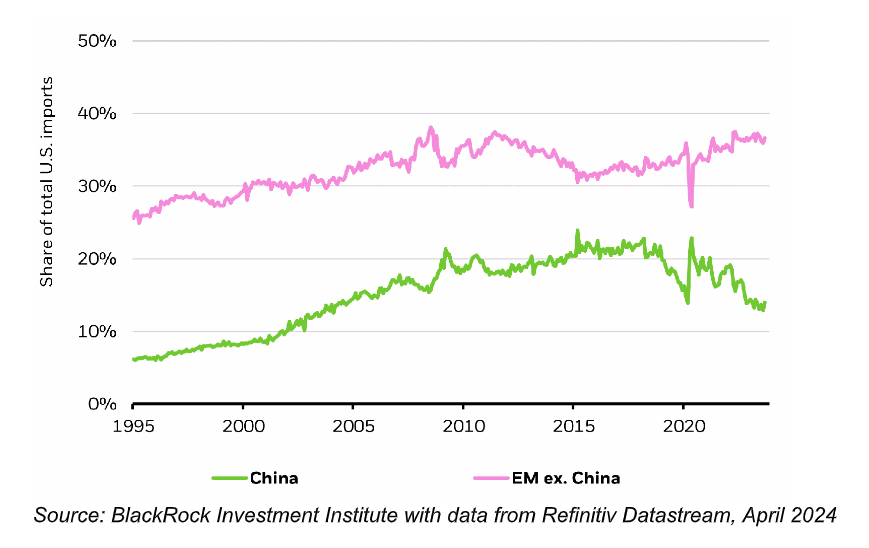
At the same time as China’s significance as a component of EM has risen, its growth has been challenged by various factors, including structural transitions taking place in the economy and strict regulations. China’s share of US imports has shrunk to less than 15 per cent as trade tensions between the two nations continue to simmer, while its share of working age population has been declining since 2010. 
In the shorter term, Chinese consumers continue to be cautious and hold on to a greater proportion of savings in the post-pandemic era, while it is not clear whether a host of government stimulus measures will be effective in reversing the downturn in its property market.

While these challenges may well create investment opportunities in time, it suggests China may need to be viewed in a different way by investors – and potentially segmented from the rest of EM, so investors can scale up or down their exposure to China depending on their view of the opportunities and risks in the Chinese market.

Treating the two regions separately may also reduce volatility across the portfolio. By looking at both the three and five-year time periods, the MSCI China index has exhibited a standard deviation of 30 per cent and 27 per cent respectively, compared to 18 per cent and 19 per cent for the MSCI Emerging Markets index. 

This indicates significantly higher volatility coming from China. BlackRock analysis also shows that excluding China entirely from the MSCI World index and reallocating that exposure to EM ex-China would boost risk-adjusted returns across one, three and five-year time periods. 

EM ex-China: Where are the opportunities?

Emerging market economies are positioned to benefit from some of the key ‘mega forces’ driving the lion’s share of growth opportunities in today’s investment landscape. The most dominant of these forces in recent months has been artificial intelligence, where Taiwan is a leader: almost 15 per cent of its GDP is derived from technology, and the locally headquartered Taiwan Semiconductor Manufacturing Company (TSMC) currently the world’s largest producer of semiconductor chips. 

With geopolitical fragmentation on the rise and the global economy splitting into competing blocs, markets such as commodity-rich Brazil – with its valuable resources and supply inputs, as well as a diverse export base across Asia, Europe, and the Americas – are also well-positioned to benefit.

Demographic change will also likely play a role in long-term growth as markets with younger populations claim an advantage, in addition, the share of the population that is working age in India is set to overtake China by 2030 so we expect demographics to act as a tailwind for the region. 

Economies that make up the EM ex-China index typically derive around 70 per cent of their revenue from other EM markets (including China), and the slowdown of growth in China has been somewhat of a positive force for these economies.

Disinflationary forces have meant central bank authorities are more inclined to cut interest rates, in comparison to developed markets where rate cuts may still be months off.

This combination of positive macro forces has been reflected in the strong performance of the MSCI EM ex China Index, which returned over 15 per cent in the year to May 2024, compared to around 12 per cent for the broad EM index which does include China. 

Longer term, EM ex-China has also outperformed broader EM, returning 6.5 per cent for the five years to May versus 3.5 per cent for broader EM. 

Getting granular

A modular approach that splits EM and China allocations allows investors to pivot more nimbly as tactical opportunities arise. One option is to replace the traditional EM exposure with a proportionate combination of China and EM ex China exposures, which resembles the broader EM including China index but provides a ‘lever’ to over-or underweight China based on the market outlook. 

Using ETFs as building blocks, it’s easy to take this approach while keeping portfolio costs low and taking advantage of the liquidity of the ETF structure to respond rapidly to market events.

Depending on your own investment views, it’s possible to adjust and blend your allocation to EM economies through a combination of broad EM, EM ex-China, Chinese equities, and EM fixed income. 

With macro forces likely to lead to decidedly different outcomes for China versus the rest of EM, we believe having the ability to be more dynamic and selective with opportunities across these markets could be valuable.

Tamara Stats is lead iShares ETF specialist at BlackRock Australasia.

 

Tags: BlackrockChinaEmerging MarketsETFs

Related Posts

Betashares fixed income ETF hits $1bn milestone

by Staff
December 16, 2025

A strong demand for core fixed income solutions has seen the Betashares Australian Composite Bond ETF surpass $1 billion in...

Vanguard giant leads ETF decline in November

by Laura Dew
December 12, 2025

Total monthly ETF inflows declined by 28 per cent from highs in November with Vanguard’s $21bn Australian Shares ETF faring...

Schroders expands fixed income management team

by Laura Dew
December 12, 2025

Schroders has appointed a fund manager to its $6.9 billion fixed income team who joins from Macquarie Asset Management.

Leave a Reply Cancel reply

Your email address will not be published. Required fields are marked *

VIEW ALL
Promoted Content

Consistency is the most underrated investment strategy.

In financial markets, excitement drives headlines. Equity markets rise, fall, and recover — creating stories that capture attention. Yet sustainable...

by Industry Expert
November 5, 2025
Promoted Content

Jonathan Belz – Redefining APAC Access to US Private Assets

Winner of Executive of the Year – Funds Management 2025After years at Goldman Sachs and Credit Suisse, Jonathan Belz founded...

by Staff Writer
September 11, 2025
Promoted Content

Real-Time Settlement Efficiency in Modern Crypto Wealth Management

Cryptocurrency liquidity has become a cornerstone of sophisticated wealth management strategies, with real-time settlement capabilities revolutionizing traditional investment approaches. The...

by PartnerArticle
September 4, 2025
Editorial

Relative Return: How fixed income got its defensiveness back

In this episode of Relative Return, host Laura Dew chats with Roy Keenan, co-head of fixed income at Yarra Capital...

by Laura Dew
September 4, 2025

Join our newsletter

View our privacy policy, collection notice and terms and conditions to understand how we use your personal information.

Podcasts

Relative Return Insider: RBA holds, Fed cuts and Santa’s set to rally

December 11, 2025

Relative Return Insider: GDP rebounds and housing squeeze getting worse

December 5, 2025

Relative Return Insider: US shares rebound, CPI spikes and super investment

November 28, 2025

Relative Return Insider: Economic shifts, political crossroads, and the digital future

November 14, 2025

Relative Return: Helping Australians retire with confidence

November 11, 2025

Relative Return Insider: RBA holds rates steady amid inflation concerns

November 6, 2025

Top Performing Funds

FIXED INT - AUSTRALIA/GLOBAL BOND
Fund name
3 y p.a(%)
1
DomaCom DFS Mortgage
211.38
2
Loftus Peak Global Disruption Fund Hedged
110.90
3
SGH Income Trust Dis AUD
80.01
4
Global X 21Shares Bitcoin ETF
76.11
5
Smarter Money Long-Short Credit Investor USD
67.63
Money Management provides accurate, informative and insightful editorial coverage of the Australian financial services market, with topics including taxation, managed funds, property investments, shares, risk insurance, master trusts, superannuation, margin lending, financial planning, portfolio construction, and investment strategies.

Subscribe to our newsletter

View our privacy policy, collection notice and terms and conditions to understand how we use your personal information.

About Us

  • About
  • Advertise
  • Contact
  • Terms & Conditions
  • Privacy Collection Notice
  • Privacy Policy

Popular Topics

  • Financial Planning
  • Funds Management
  • Investment Insights
  • ETFs
  • People & Products
  • Policy & Regulation
  • Superannuation

© 2025 All Rights Reserved. All content published on this site is the property of Prime Creative Media. Unauthorised reproduction is prohibited

No Results
View All Results
NEWSLETTER
  • News
    • All News
    • Accounting
    • Financial Planning
    • Funds Management
    • Life/Risk
    • People & Products
    • Policy & Regulation
    • Property
    • SMSF
    • Superannuation
    • Tech
  • Investment
    • All Investment
    • Australian Equities
    • ETFs
    • Fixed Income
    • Global Equities
    • Managed Accounts
  • Features
    • All Features
    • Editorial
    • Expert Analysis
    • Guides
    • Outsider
    • Rate The Raters
    • Top 100
  • Media
    • Events
    • Podcast
    • Webcasts
  • Promoted Content
  • Investment Centre
  • Expert Resources
  • About
  • Advertise
  • Contact Us

© 2025 All Rights Reserved. All content published on this site is the property of Prime Creative Media. Unauthorised reproduction is prohibited