
X
  • About
  • Advertise
  • Contact
  • Expert Resources
Get the latest news! Subscribe to the Money Management bulletin
  • News
    • Accounting
    • Financial Planning
    • Funds Management
    • Life/Risk
    • People & Products
    • Policy & Regulation
    • Property
    • SMSF
    • Superannuation
    • Tech
  • Investment
    • Australian Equities
    • Global Equities
    • Managed Accounts
    • Fixed Income
    • ETFs
  • Features
    • Editorial
    • Expert Analysis
    • Guides
    • Outsider
    • Rate The Raters
    • Top 100
  • Media
    • Events
    • Podcast
    • Webcasts
  • Promoted Content
  • Investment Centre
No Results
View All Results
  • News
    • Accounting
    • Financial Planning
    • Funds Management
    • Life/Risk
    • People & Products
    • Policy & Regulation
    • Property
    • SMSF
    • Superannuation
    • Tech
  • Investment
    • Australian Equities
    • Global Equities
    • Managed Accounts
    • Fixed Income
    • ETFs
  • Features
    • Editorial
    • Expert Analysis
    • Guides
    • Outsider
    • Rate The Raters
    • Top 100
  • Media
    • Events
    • Podcast
    • Webcasts
  • Promoted Content
  • Investment Centre
No Results
View All Results
No Results
View All Results
Home Features Editorial

Low interest rates lend support to US equities

by Mark Thomas
August 14, 2014
in Editorial, Features
Reading Time: 4 mins read
Share on FacebookShare on Twitter

Accommodative monetary policy in the US is set to continue, which should see the equity market climb higher, Mark Thomas writes.  

The US Federal Reserve has a dual mandate to achieve core inflation of two per cent and full employment, measured by an unemployment rate of 5.5 per cent.  

X

However, despite being close to achieving these targets, Fed chair Janet Yellen has repeatedly said loose monetary policy is still required due to excess capacity in the US economy, as measured by the very low participation rate and high underemployment. 

Therefore, there are conflicting signals and views related to US monetary policy and quantitative easing. 

The Fed’s stated commitment to reach two per cent inflation and full employment appears to be rhetoric, with Yellen’s comments suggesting the Fed is focused on boosting inflation at any cost to erode the real value of the nation’s mounting debt pile. 

The US government’s rising debt-to-GDP ratio could have serious implications for economic growth, especially if interest rates rise. 

It seems increasingly likely that the Fed will maintain accommodative policy and keep rates low for longer. This could also extend the US equity market’s bull run, although it’s likely to be a bumpy ride higher.  

The US recorded a debt-to-GDP of 71.8 per cent in 2013, according to the CIA World Fact Book, or 101.53 per cent including external debt, according to the US Bureau of Public Debt. By comparison, US debt-to-GDP averaged 60.81 per cent from 1940 to 2013. 

Debt-to-GDP measures the financial leverage of an economy. When interest rates are low, interest coverage costs are relatively low; however, in a rising interest rate environment, US growth could be slowed down for decades. 

In order to achieve a healthy debt-to-GDP ratio of 30 per cent, accommodative US monetary policy needs to remain in place.  

Yellen’s comments are inconsistent with the Fed’s own fundamental signal, which is illustrated in Graph 1. 
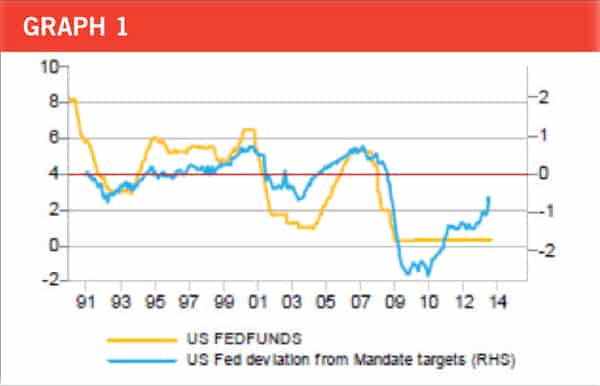
It’s becoming clearer that the Fed wants to keep liquidity conditions accommodative until consumer spending and business investment kick in. To date these two parts of economic growth have been missing in the recovery despite very low long-term interest rates, improved household wealth and strong profits for US corporates. 

The view is that the Fed is also concerned that any rise in interest rates will potentially undermine the recovery and reintroduce financial instability back into the US financial system. 

Taking a broader, longer term view of the US economy, the US government has found itself in this position many times before. Debt blowouts are common throughout US history. The US government borrowed 40 per cent of GDP to pay for the Civil War but by 1915, it had almost paid back that debt. After World War I, the debt-to-GDP ratio rose to around 40 per cent again, and after World War II, it peaked at over 120 per cent.  
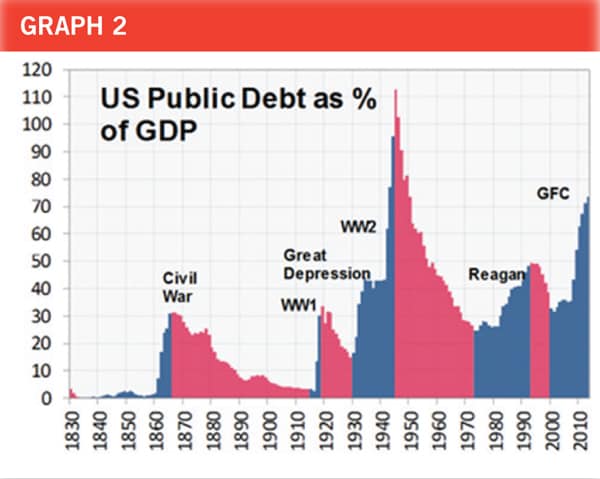
The only realistic way out of debt is to grow nominal GDP faster than the total debt balance. 

Currently the total debt balance for the US is roughly 70 per cent of GDP which, according to the World Bank, was $16.8 trillion in 2013.  Simplistically with bond yields at 2.5 per cent US nominal GDP needs to grow at 1.8 per cent just to keep pace with the debt pile.  However the debt pile is not static and is actually growing at a rate of QE purchases plus interest at the government bond yield rate. The US budget deficit contributes a further half a trillion dollars to the pile each year.  

Table 1 attempts to break down the situation in a very simplified way. 
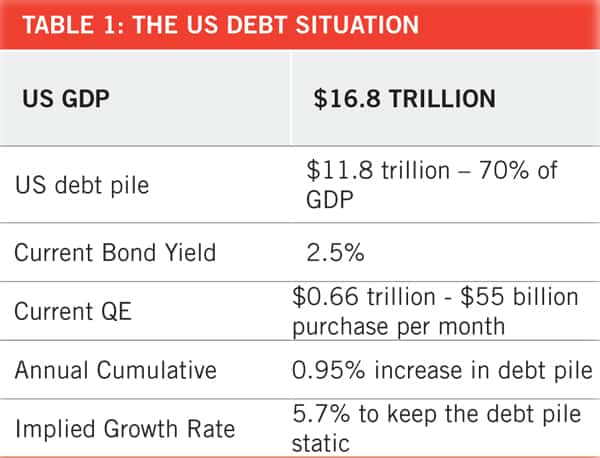
This simple calculation suggests that nominal GDP needs to grow at 5.7 per cent per annum to keep the debt pile static if bond purchases remain at $55 billion per month and bond rates remain at 2.5 per cent. 

Assuming that bond purchases go to zero and the US can manufacture nominal GDP growth of four per cent over 10 years, keeping bond yields at 2.5 per cent, it would take decades to return the debt-to-GDP ratio back to less than 10 per cent.  This suggests that accommodative monetary policy/ QE will be here for much longer than most expect, possibly five to 10 years rather than three to five years. Consider that it took the US government 30 years to deleverage after WWII.  

Mark Thomas is chief executive and chief investment officer of van Eyk Research.

Tags: CentChief ExecutiveChief Investment OfficerInterest RatesVan EykVan Eyk Research

Related Posts

Relative Return Insider: RBA holds, Fed cuts and Santa’s set to rally

by Staff
December 11, 2025

In this episode of Relative Return Insider, host Keith Ford and AMP chief economist Shane Oliver unpack the RBA’s decision...

Relative Return Insider: GDP rebounds and housing squeeze getting worse

by Staff Writer
December 5, 2025

In this episode of Relative Return Insider, host Keith Ford and AMP chief economist Shane Oliver discuss the September quarter...

The Manager Mix – Alternatives: Haley Devine of MaxCap Group

by Staff
December 5, 2025

In this new episode of The Manager Mix, host Laura Dew speaks to Haley Devine, head of wealth management at...

Leave a Reply Cancel reply

Your email address will not be published. Required fields are marked *

VIEW ALL
Promoted Content

Consistency is the most underrated investment strategy.

In financial markets, excitement drives headlines. Equity markets rise, fall, and recover — creating stories that capture attention. Yet sustainable...

by Industry Expert
November 5, 2025
Promoted Content

Jonathan Belz – Redefining APAC Access to US Private Assets

Winner of Executive of the Year – Funds Management 2025After years at Goldman Sachs and Credit Suisse, Jonathan Belz founded...

by Staff Writer
September 11, 2025
Promoted Content

Real-Time Settlement Efficiency in Modern Crypto Wealth Management

Cryptocurrency liquidity has become a cornerstone of sophisticated wealth management strategies, with real-time settlement capabilities revolutionizing traditional investment approaches. The...

by PartnerArticle
September 4, 2025
Editorial

Relative Return: How fixed income got its defensiveness back

In this episode of Relative Return, host Laura Dew chats with Roy Keenan, co-head of fixed income at Yarra Capital...

by Laura Dew
September 4, 2025

Join our newsletter

View our privacy policy, collection notice and terms and conditions to understand how we use your personal information.

Podcasts

Relative Return Insider: RBA holds, Fed cuts and Santa’s set to rally

December 11, 2025

Relative Return Insider: GDP rebounds and housing squeeze getting worse

December 5, 2025

Relative Return Insider: US shares rebound, CPI spikes and super investment

November 28, 2025

Relative Return Insider: Economic shifts, political crossroads, and the digital future

November 14, 2025

Relative Return: Helping Australians retire with confidence

November 11, 2025

Relative Return Insider: RBA holds rates steady amid inflation concerns

November 6, 2025

Top Performing Funds

FIXED INT - AUSTRALIA/GLOBAL BOND
Fund name
3 y p.a(%)
1
DomaCom DFS Mortgage
211.38
2
Loftus Peak Global Disruption Fund Hedged
110.90
3
SGH Income Trust Dis AUD
80.01
4
Global X 21Shares Bitcoin ETF
76.11
5
Smarter Money Long-Short Credit Investor USD
67.63
Money Management provides accurate, informative and insightful editorial coverage of the Australian financial services market, with topics including taxation, managed funds, property investments, shares, risk insurance, master trusts, superannuation, margin lending, financial planning, portfolio construction, and investment strategies.

Subscribe to our newsletter

View our privacy policy, collection notice and terms and conditions to understand how we use your personal information.

About Us

  • About
  • Advertise
  • Contact
  • Terms & Conditions
  • Privacy Collection Notice
  • Privacy Policy

Popular Topics

  • Financial Planning
  • Funds Management
  • Investment Insights
  • ETFs
  • People & Products
  • Policy & Regulation
  • Superannuation

© 2025 All Rights Reserved. All content published on this site is the property of Prime Creative Media. Unauthorised reproduction is prohibited

No Results
View All Results
NEWSLETTER
  • News
    • All News
    • Accounting
    • Financial Planning
    • Funds Management
    • Life/Risk
    • People & Products
    • Policy & Regulation
    • Property
    • SMSF
    • Superannuation
    • Tech
  • Investment
    • All Investment
    • Australian Equities
    • ETFs
    • Fixed Income
    • Global Equities
    • Managed Accounts
  • Features
    • All Features
    • Editorial
    • Expert Analysis
    • Guides
    • Outsider
    • Rate The Raters
    • Top 100
  • Media
    • Events
    • Podcast
    • Webcasts
  • Promoted Content
  • Investment Centre
  • Expert Resources
  • About
  • Advertise
  • Contact Us

© 2025 All Rights Reserved. All content published on this site is the property of Prime Creative Media. Unauthorised reproduction is prohibited



