Equity investors have long embraced factor-based investing – using factors such as quality, value and momentum – to improve portfolio performance.
Decades of research confirm that these strategies can lead to consistent historical outperformance compared to
the broader stock market. Meanwhile, investors have made a massive push to apply artificial intelligence (AI) to their investment processes to boost performance and mitigate risk.
With increased data availability and the advancement of AI techniques – including the potential to identify and exploit new connections in financial markets – the question is no longer if AI can improve investment strategies—but how.
A new opportunity emerges at the crossroads of factor investing and advanced machine learning techniques—this is what we call dynamic factor investing. New research from Northern Trust Asset Management and the University of Chicago explores this area of intersection, and how investors can apply factor investing and AI in the context of traditional modern portfolio theory.
AI: Avoid the pitfalls to potentially enhance outcomes
AI’s ability to sift through enormous datasets and detect patterns – a function called machine learning – has exciting potential for investing. Yet investors are just getting started on how to use it. The exciting possibilities include better predictions of return and risk, more efficient portfolios and the uncovering of hidden patterns. However, these techniques also come with significant user warnings. Common pitfalls that can undermine their effectiveness include misapplication, overreliance on single and non-transparent estimates, and over-fitting
models to historical data.
Our research demonstrates that to fully leverage the benefits of AI while sidestepping its pitfalls in factor timing, investors can adopt a more dynamic approach. By integrating AI into the investment process, we can enhance traditional factor timing techniques, moving beyond static models to a more adaptive strategy.
Factor timing: From static to dynamic
Factor returns fluctuate over time. One step investors can take to mitigate this cyclicality is to diversify across multiple factors. But can they go a step further and time these factor cycles? Briefly, factor timing involves identifying relationships between key variables such as sentiment, valuation, or the current business cycle and how they influence factor returns. For example, research may reveal that factors that have historically performed well will continue to do so. In a timing framework, this would lead us to overweight those factors showing recent positive momentum, and underweight others showing weaker performance.
However, most prevailing factor timing techniques are static in nature. While the weightings of factors shift over time, these static approaches ignore the dynamic relationship between predictor variables and factors. For example, relying solely on momentum to time factors may not be the most effective strategy in every scenario.
Recognising that, in reality, factor relationships are not constant, we aimed in our research to build upon static approaches and create a dynamic approach to capture changing relationships in a factor timing approach. This resulted in our dynamic factor timing framework, which sits at the intersection of modern portfolio theory and AI.
Specifically, we applied a standard mean-variance approach — the cornerstone of modern portfolio theory — along with an AI technique known as regularisation. This uses data-driven scepticism to digest incoming data in a systematic manner, and then dynamically adjust the factor weights to produce the optimal allocations in a portfolio.
Here’s how it works:
– If factor timing is deemed temporarily ineffective, the AI model may step back, reducing or stopping factor timing altogether. Instead, it will use an equal-weighted portfolio, treating all factors the same. This occurs when the AI model indicates high scepticism.
– Conversely, when the model has more confidence, or low scepticism, it will lean into dynamic factor timing, adjusting the portfolio based on which factors are performing best.
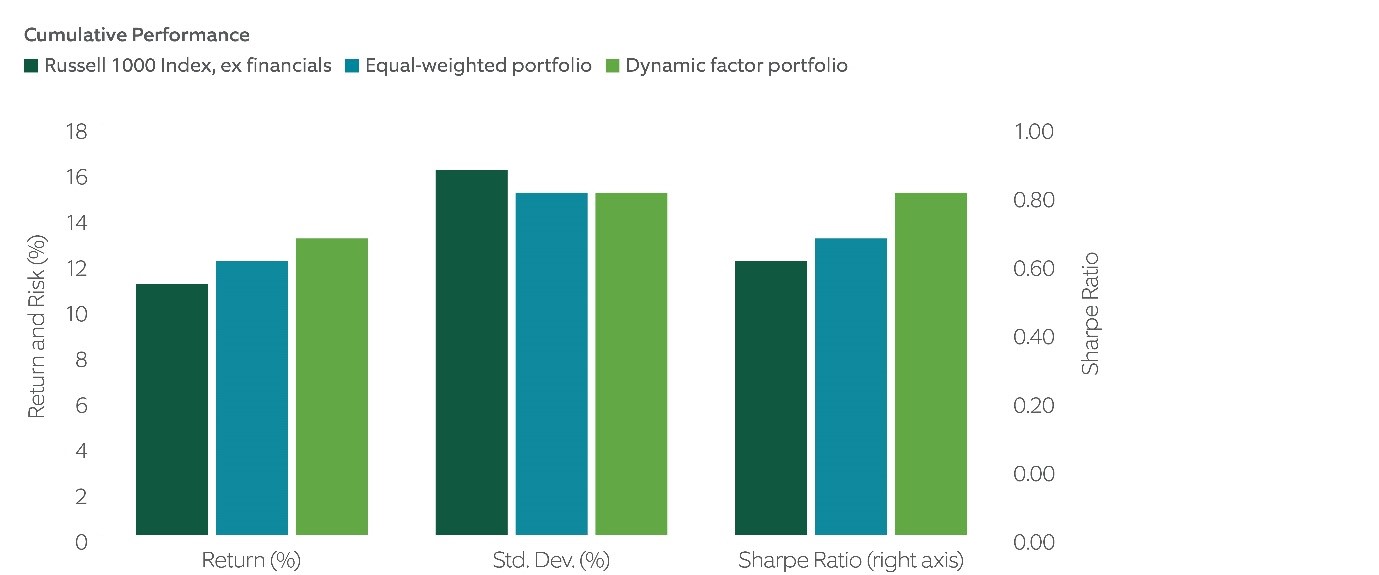
We tested this framework using a long-only portfolio of value, momentum and quality factors. The results (Exhibit 1) were clear:
– An equal-weighted factor portfolio outperformed the Russell 1000 Index (excluding the financial sector), which is consistent with the literature on factor investing.
– Our dynamic factor timing approach further improved returns by an average of 1.5 per cent per year, with slightly lower risk.
– Combining these, we can see a meaningful pick-up in Sharpe ratio (a key measure of risk-adjusted returns) from 0.66 for the index to 0.75 for the equal-weighted factor portfolio all the way up to 0.82 for the dynamic factor portfolio.
Overall, these results clearly show how this methodology can enhance both returns and risk management in a multi-factor portfolio, offering investors a more dynamic and efficient approach to navigating market complexities.
Exhibit 1: Hypothetical: The Outperformance of Dynamic Factor Timing
Our hypothetical dynamic factor portfolio outperformed the broad market, excluding the financial sector, and an equal-weighted factor portfolio on an absolute and risk-adjusted return basis.
Enhancing traditional portfolio management with AI
When it comes to AI and timing anything in financial markets, it is crucial to apply discipline. Merely identifying and exploiting relationships that are economically meaningful and showing positive long-run average results can ignore how those relationships change over time.
Traditional methods may not pick up these changes, while AI approaches are well-suited to identify them and adjust. Yet we do not want to deviate too far from the proven practice of more traditional modern portfolio theory.
Therefore, we have developed a flexible framework that combines traditional portfolio theory with the power of AI to address the challenges of static factor timing. This dynamic approach allows us to adjust factor timing based on changing market conditions, or even pause it completely if the model detects shifts in market relationships. By doing so, we provide investors with powerful tools to navigate the complexities of today’s financial markets,
helping them stay ahead of risks and seize opportunities with confidence.
Jan Rohof is director of quantitative solutions, Asia Pacific at Northern Trust Asset Management.