X
  • About
  • Advertise
  • Contact
  • Expert Resources
Get the latest news! Subscribe to the Money Management bulletin
  • News
    • Accounting
    • Financial Planning
    • Funds Management
    • Life/Risk
    • People & Products
    • Policy & Regulation
    • Property
    • SMSF
    • Superannuation
    • Tech
  • Investment
    • Australian Equities
    • Global Equities
    • Managed Accounts
    • Fixed Income
    • ETFs
  • Features
    • Editorial
    • Expert Analysis
    • Guides
    • Outsider
    • Rate The Raters
    • Top 100
  • Media
    • Events
    • Podcast
    • Webcasts
  • Promoted Content
  • Investment Centre
No Results
View All Results
  • News
    • Accounting
    • Financial Planning
    • Funds Management
    • Life/Risk
    • People & Products
    • Policy & Regulation
    • Property
    • SMSF
    • Superannuation
    • Tech
  • Investment
    • Australian Equities
    • Global Equities
    • Managed Accounts
    • Fixed Income
    • ETFs
  • Features
    • Editorial
    • Expert Analysis
    • Guides
    • Outsider
    • Rate The Raters
    • Top 100
  • Media
    • Events
    • Podcast
    • Webcasts
  • Promoted Content
  • Investment Centre
No Results
View All Results
No Results
View All Results
Home Investment Insights Fixed Income

Enhancing returns in fixed income markets

Active management in fixed income remains a compelling strategy, leveraging market inefficiencies to generate excess returns and manage risk, often more effectively than passive alternatives, writes Adam Whiteley.

by Industry Expert
March 5, 2025
in Expert Analysis, Fixed Income, Investment Insights
Reading Time: 5 mins read
Share on FacebookShare on Twitter

Active management in fixed income remains a compelling strategy, leveraging market inefficiencies to generate excess returns and manage risk, often more effectively than passive alternatives.

Some investors believe that the best approach to investment is always via a low-cost passive strategy, as they assume that active managers structurally underperform once fees are factored in.

X

While this perception can hold true in equity markets, fixed income markets tell a different story. Structural inefficiencies, market fragmentation, and passive investing distortions create opportunities for skilled managers to outperform, and many active managers meaningfully beat their benchmarks even after fees. 

This means investors need to look for managers with a robust investment process that are able to achieve consistent net of fee outperformance by navigating the risk and opportunities.

Active managers do generally add value in fixed income

Many investors contend that active managers struggle to outperform their benchmarks across all asset classes. While this can hold true for equity strategies, the same cannot be said for fixed income. In contrast to equities, fixed income markets tend to be less efficient and transparent, creating opportunities for active managers to outperform benchmarks and generate excess returns.

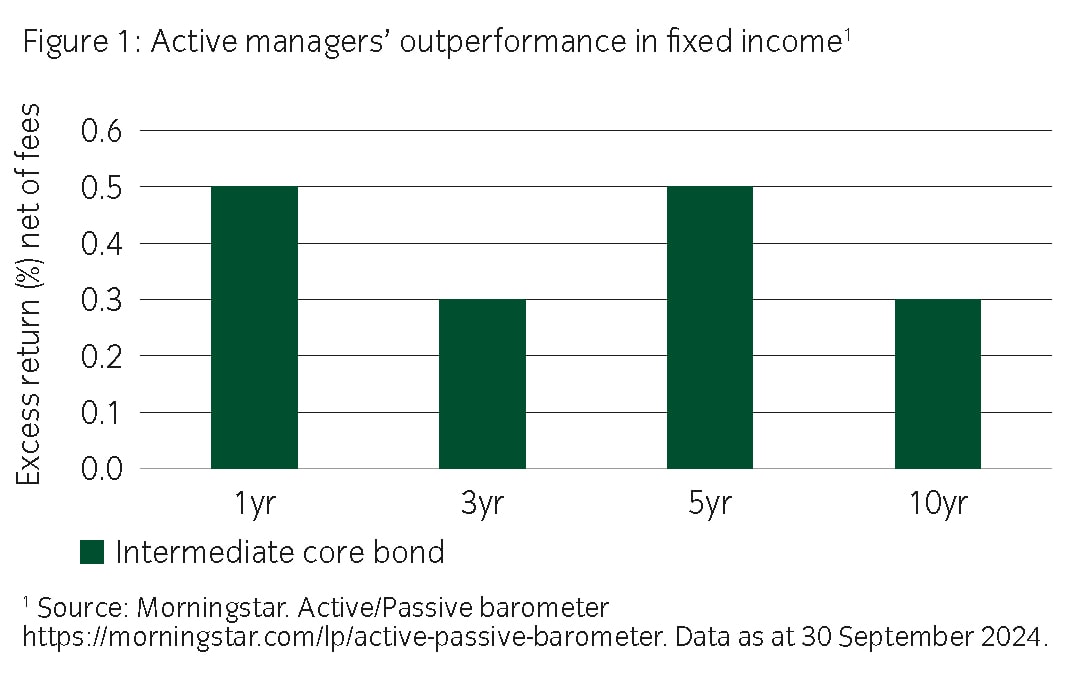
These inefficiencies are further amplified by the rise of passive investing. Consequently, data from Morningstar shows that active managers have historically generated long-term returns well above their passive counterparts in intermediate core bond portfolios, which typically hold a mix of US government bonds and investment grade credit.
Beating benchmarks and exploiting inefficiencies

Fixed income managers employ a range of strategies to add value in fixed income through different market conditions. This includes strategic portfolio positioning based on interest rate expectations, and fundamental credit analysis to identify mispriced securities whose valuations fail to reflect their current and future fundamental strength or weakness.

Market fragmentation also provides further inefficiencies to exploit, allowing managers to select optimal bonds based on personal risk appetite across universes of bonds that extend to tens of thousands. Active managers, importantly, have the flexibility to adjust their credit exposure, and can take on higher or lower credit risk compared to the index, based on these preferences.

Whole industry sectors in fixed income markets can sometimes be mispriced, often due to sector-specific economic cycles or excessive leverage. Unlike passive strategies, active managers can be flexible enough to avoid investing in these sectors ahead of time but then increase exposure when they believe the risks are in the price.

The hidden risks of passive investing

Investors in fixed income should be aware of the shortcomings of many traditional fixed income indices when pursuing an investment strategy.

Unlike equity indices, which favour the largest and most successful companies, fixed income indices are skewed toward the most indebted issuers – both corporate and sovereign – often leading to instances of poor diversification and excessive concentration in highly leveraged sectors or countries.

Moreover, passive strategies are inherently reactive. Bonds drop out of many indices as they approach maturity or are downgraded below investment-grade status, forcing passive funds to sell at inopportune times, particularly during economic downturns. 

This challenge for passive investors is further compounded by the fact that investment grade indices are increasingly dominated by BBB-rated bonds, as companies have taken on greater leverage, while the highest quality AAA and AA-rated bonds now represent less than 10 per cent of the market.

Compounding these risks, passive bond funds face ongoing transaction costs and rebalancing inefficiencies, which structurally hinder performance relative to actively managed alternatives.

Volatility is the friend of active managers

Bonds are misvalued more frequently during periods of market volatility, and sharp market moves can create valuable opportunities for active managers with robust investment processes.

Bond market volatility has grown markedly in the last few years, driven by the COVID-19 pandemic and the rise in interest rates since 2022. We believe that this heightened volatility is likely to persist due to the evolving macroeconomic backdrop, plagued by higher interest rates, geopolitical instability, deglobalisation and fiscal looseness.
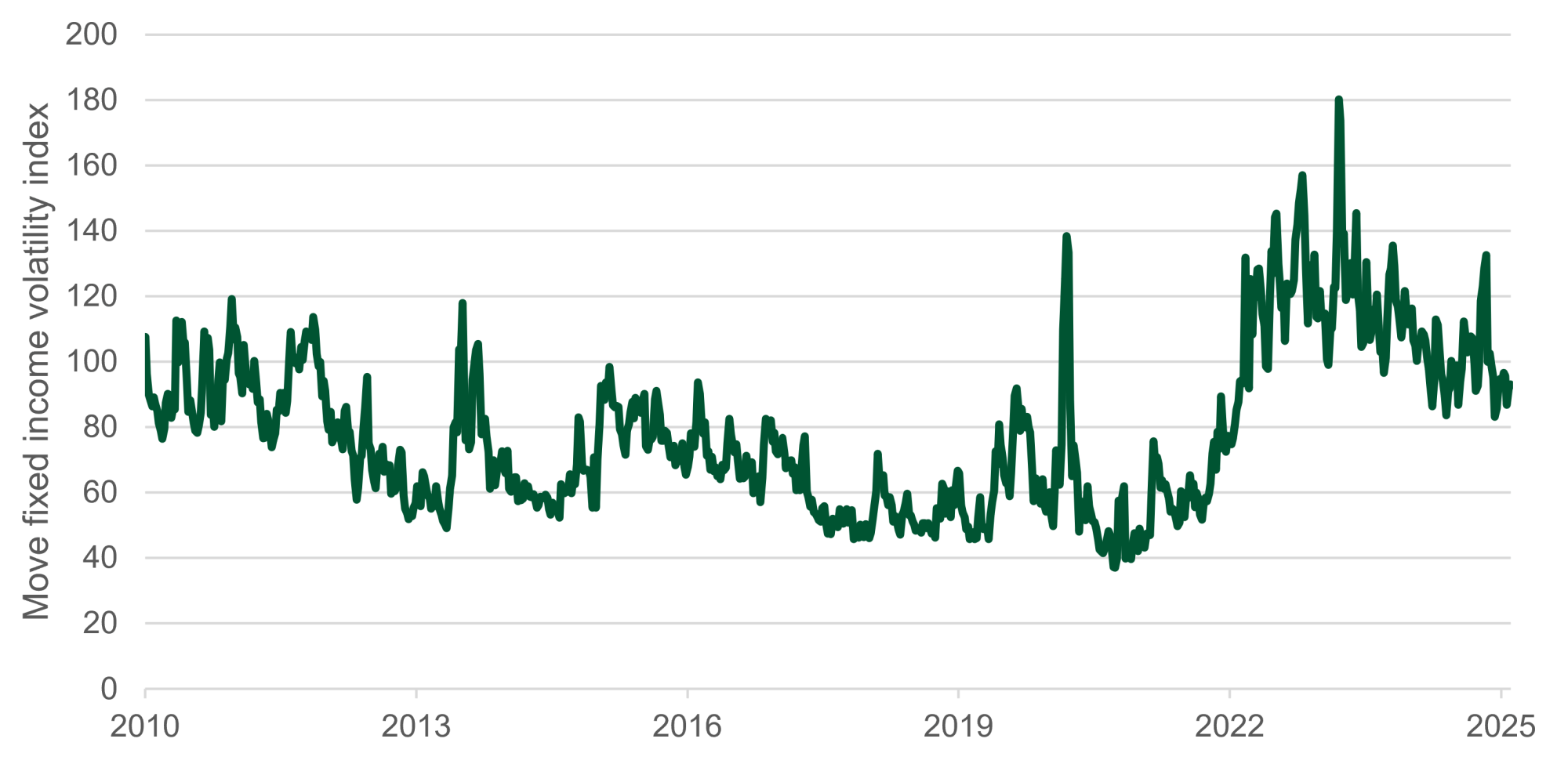
Flexible active managers generally tend to benefit from this environment since volatility often equals opportunity, creating the ideal conditions to exploit mispricings. 

Over the 12 months to end December 2024, returns and volatility across major fixed income segments diverged significantly. Notably, US high-yield credit delivered higher returns with lower volatility than expected. This is an example of how markets can defy conventional wisdom.

A flexible active manager can work to pinpoint the drivers behind these trends and position portfolios accordingly, turning volatility into an advantage.

Winning by not losing

For investors focused on safe and reliable cashflows rather than return maximisation, active managers play a crucial role. Skilled managers can identify undervalued securities, construct a diversified portfolio, and steer clear of issuers at risk of default or credit deterioration.

The case for active management

The case for active management in fixed income is clear. Bond markets present unique inefficiencies that active managers can exploit, whether by identifying mispriced securities, adjusting credit exposure dynamically, or proactive sector rotation.

Market volatility, structural flaws in traditional bond indices, and the limitations of passive strategies further reinforce the importance of active decision-making. However, careful manager selection is crucial in ensuring a robust investment process that delivers repeatable above benchmark returns over time.

Adam Whiteley is head of global credit at Insight Investment.

Tags: Active ManagementActive ManagersFixed IncomeInsight Investment

Related Posts

Betashares fixed income ETF hits $1bn milestone

by Staff
December 16, 2025

A strong demand for core fixed income solutions has seen the Betashares Australian Composite Bond ETF surpass $1 billion in...

Vanguard giant leads ETF decline in November

by Laura Dew
December 12, 2025

Total monthly ETF inflows declined by 28 per cent from highs in November with Vanguard’s $21bn Australian Shares ETF faring...

Schroders expands fixed income management team

by Laura Dew
December 12, 2025

Schroders has appointed a fund manager to its $6.9 billion fixed income team who joins from Macquarie Asset Management.

Leave a Reply Cancel reply

Your email address will not be published. Required fields are marked *

VIEW ALL
Promoted Content

Consistency is the most underrated investment strategy.

In financial markets, excitement drives headlines. Equity markets rise, fall, and recover — creating stories that capture attention. Yet sustainable...

by Industry Expert
November 5, 2025
Promoted Content

Jonathan Belz – Redefining APAC Access to US Private Assets

Winner of Executive of the Year – Funds Management 2025After years at Goldman Sachs and Credit Suisse, Jonathan Belz founded...

by Staff Writer
September 11, 2025
Promoted Content

Real-Time Settlement Efficiency in Modern Crypto Wealth Management

Cryptocurrency liquidity has become a cornerstone of sophisticated wealth management strategies, with real-time settlement capabilities revolutionizing traditional investment approaches. The...

by PartnerArticle
September 4, 2025
Editorial

Relative Return: How fixed income got its defensiveness back

In this episode of Relative Return, host Laura Dew chats with Roy Keenan, co-head of fixed income at Yarra Capital...

by Laura Dew
September 4, 2025

Join our newsletter

View our privacy policy, collection notice and terms and conditions to understand how we use your personal information.

Podcasts

Relative Return Insider: RBA holds, Fed cuts and Santa’s set to rally

December 11, 2025

Relative Return Insider: GDP rebounds and housing squeeze getting worse

December 5, 2025

Relative Return Insider: US shares rebound, CPI spikes and super investment

November 28, 2025

Relative Return Insider: Economic shifts, political crossroads, and the digital future

November 14, 2025

Relative Return: Helping Australians retire with confidence

November 11, 2025

Relative Return Insider: RBA holds rates steady amid inflation concerns

November 6, 2025

Top Performing Funds

FIXED INT - AUSTRALIA/GLOBAL BOND
Fund name
3 y p.a(%)
1
DomaCom DFS Mortgage
211.38
2
Loftus Peak Global Disruption Fund Hedged
110.90
3
SGH Income Trust Dis AUD
80.01
4
Global X 21Shares Bitcoin ETF
76.11
5
Smarter Money Long-Short Credit Investor USD
67.63
Money Management provides accurate, informative and insightful editorial coverage of the Australian financial services market, with topics including taxation, managed funds, property investments, shares, risk insurance, master trusts, superannuation, margin lending, financial planning, portfolio construction, and investment strategies.

Subscribe to our newsletter

View our privacy policy, collection notice and terms and conditions to understand how we use your personal information.

About Us

  • About
  • Advertise
  • Contact
  • Terms & Conditions
  • Privacy Collection Notice
  • Privacy Policy

Popular Topics

  • Financial Planning
  • Funds Management
  • Investment Insights
  • ETFs
  • People & Products
  • Policy & Regulation
  • Superannuation

© 2025 All Rights Reserved. All content published on this site is the property of Prime Creative Media. Unauthorised reproduction is prohibited

No Results
View All Results
NEWSLETTER
  • News
    • All News
    • Accounting
    • Financial Planning
    • Funds Management
    • Life/Risk
    • People & Products
    • Policy & Regulation
    • Property
    • SMSF
    • Superannuation
    • Tech
  • Investment
    • All Investment
    • Australian Equities
    • ETFs
    • Fixed Income
    • Global Equities
    • Managed Accounts
  • Features
    • All Features
    • Editorial
    • Expert Analysis
    • Guides
    • Outsider
    • Rate The Raters
    • Top 100
  • Media
    • Events
    • Podcast
    • Webcasts
  • Promoted Content
  • Investment Centre
  • Expert Resources
  • About
  • Advertise
  • Contact Us

© 2025 All Rights Reserved. All content published on this site is the property of Prime Creative Media. Unauthorised reproduction is prohibited